Tuesday, 24 May 2016
Vavel USA - And The Return Of The Men
I recently had the honour of being asked to write for Vavel USA, something of a burgeoning website, particularly when it comes to extensive tennis coverage. You can read my article on Johanna Konta by clicking on this link: http://www.vavel.com/en-us/tennis-usa/646446-eastbournes-johanna-konta-takes-on-the-world.html?utm_source=dlvr.it&utm_medium=twitter. It's an adapted and updated version of my previous blogpost (written during the Australian Open in January), now including her great run to the Miami quarter finals, and her build up to the French Open. It also covers the recent news that the men will be returning to Eastbourne's Aegon International from next year, as well as the first announcements of the entrants for this year's event. More tennis news can be found on this blog's twitter page.

Friday, 29 January 2016
From Eastbourne To The World - Johanna Konta Hits The Heights
She's known as "Eastbourne's Johanna Konta" to many, particularly to people in the part of the world where the WTA converges for one of its most popular tournaments - a week of intense competition, and practice, in a contrastingly relaxed atmosphere - the week before the bustle of Wimbledon. The Aegon International.
And last year's Aegon International saw "local" girl Konta begin her incredible journey from a player ranked way below 100 in the world, who had rarely even played a top player, to where she is now, just a few months later - regularly beating players in the world's top 20, and even top 10; reaching the last 16 at two consecutive Grand Slams; about to be ranked in the world's TOP THIRTY; and reaching a Major Semi Final.
 |
| Konta celebrates winning through to the Australian Open Semi Finals http://www.gettyimages.co.uk/detail/news-photo/johanna-konta-of-great-britain-celebrates-winning-her-news-photo/507009742 |
 |
| Her brilliant run ends in the Semi Finals, to 7th seed Angelique Kerber http://www.independent.co.uk/sport/tennis/johanna-konta-out-of-australian-open-britons-run-comes-to-an-end-in-semi-final-against-angelique-a6838371.html |
It's no surprise - and completely understandable - that many at the venue of her latest achievements, the Australian Open, were keen to point out that, although she's now proudly British number one, she was born in Sydney, trained at the Aussie Open site at Melbourne Park as a child, and represented Australia until 2012!
I first heard of her, shortly before she took UK citizenship in May 2012, via the editor of EastbourneTennis.com, a site I'd contributed articles to. At the time, she was ranked 208 in the world, and became British No 6. There was certainly a degree of excitement that a promising player, who'd just turned 21, and who had moved to the UK with her Hungarian parents in 2005, was now to play for Britain. Even more excitement that the Aegon International could have a hometown player, given that she's lived in Eastbourne for the last few years.
We couldn't, though, have predicted the success she would have that week in June last year, or that she would soon go on to have in other arenas around the world.
 |
| In Hometown Action at Eastbourne's Aegon International last year http://www.telegraph.co.uk/sport/tennis/wimbledon/11693580/Wimbledon-2015-Johanna-Konta-and-Heather-Watson-gear-up-for-SW19-with-impressive-wins.html |
On a sunny but cold Sunday evening, in the Main Draw's 1st round, the world number 139 took on the world number 34, Zarina Diyas, and won. The Eastbourne crowd was a little sparse, but from the Monday and Tuesday, it quickly became apparent that the Aegon International is one of the best attended tournaments, from early on in the week, that you can find. So there was a big crowd when she beat Ekaterina Makarova, then ranked world number eight, 6-2 6-4. Her first win over a top ten opponent - but not her last.
It's perhaps fitting that it was Makarova (now ranked 24 after injury, but twice a Grand Slam semi finalist and a former Eastbourne champion) that she beat in the Australian Open 4th round, 4-6 6-4 8-6, to become the first British woman since Jo Durie (now one of the best tennis commentators out there), at Wimbledon 1984, to reach a Grand Slam quarter final.
Konta was expected to win the battle of surprise quarter finalists, playing world number 133 Shuai Zhang. So there was a lot more pressure, but she duly obliged - triumphing 6-4 6-1, to end another long British wait - this time the first British woman to reach a Grand Slam SEMI FINAL since the aforementioned Jo Durie, at the US Open in 1983.
Her glorious run finally came to an end at the hands of the Australian Open's 7th seed, Angelique Kerber (who, incidently, has twice been a runner-up at the Aegon International!), 7-5 6-2. But her achievements at this tournament have taken her astonishing progress over recent months to yet new heights, and will live long in the memory. And the memories, the emotions and the atmospheres are, she's said, what she takes most from her great matches over the past few months.
At Eastbourne, she followed up her Makarova win with another sensational victory, beating Garbine Muguruza, before succumbing, in 3 sets at the quarter final stage, to eventual champion Belinda Bencic.
On my twitter page, I'd become used to hashtag-ing "HometownWin". When Roger Federer recorded more of his own in Basel a few months later, I couldn't resist tweeting: "Another #HometownWin in #Basel for #Federer. Who does he think he is, #Eastbourne's Johanna #Konta or something?!"
Her run at Eastbourne's 2015 Aegon International provided an unexpected extra dimension to a tournament which was back to being WTA-only, after six years of being joined by the men. Traditionally attracting top female players for decades, the addition of an ATP event was not popular with all of the tournament's faithful fans. And it was a smaller ATP event and so struggled to attract the very highest ranked players of the day. But over the six years, it brought the likes of Grigor Dimitrov, Jo-Wilfried Tsonga, Lleyton Hewitt and Andy Roddick. Many were very disappointed to see the men's event go, particularly when the extension to the grass court season had raised hopes of more top names.
The week after Eastbourne, Konta played Maria Sharapova in the first round at Wimbledon, and came off second best. But then came a 16-match winning streak, taking titles at the ITF Circuit, the level just below the WTA Tour, qualifying for the US Open, and sensationally reaching the 4th round. Another incredible win over Muguruza (who now had "Wimbledon finalist" added to her list of achievements), followed by yet another top 20 scalp, Andrea Petkovic, saw her face twice Wimbledon winner Petra Kvitova in the last 16, where she lost in 2 tight sets (7-5, 6-3).
 |
| Konta repeats her Eastbourne win over Garbine Muguruza with an epic triumph at the US Open http://www.dailymail.co.uk/sport/tennis/article-3221354/British-world-No-97-Johanna-Konta-upsets-ninth-seed-Garbine-Muguruza-longest-Open-women-s-match.html |
But the bubble had not been burst. A few weeks later she qualified for the Wuhan Open, reaching the quarter finals, where she lost to Venus Williams, from 5-3 up in the final set. But on the way she beat Petkovic again; Victoria Azarenka, who retired injured after Konta won the 1st set; and World No 2 Simona Halep, from 1-5 down in the final set. At that moment in time, it wasn't inconceivable to describe her as being in the hottest form of any female tennis player on the planet.
She probably didn't want her 2015 season to end, and 2016 started with two first round losses - in Shenzhen and Hobart. Now ranked high enough for automatic entry to these events, it was wondered whether she may have lost the competitive edge that playing your way through the qualifying of an event can give a player.
But then came her Australian Open first round win over Venus. Playing one of the game's All Time Greats, now back in the world's top ten, was an incredibly tough draw. She was certainly aided by Venus being hampered with a heavily strapped thigh, but the positive power hitting and mental resolve, that few of us had expected in such abundance from Konta, was again clear for all to see.
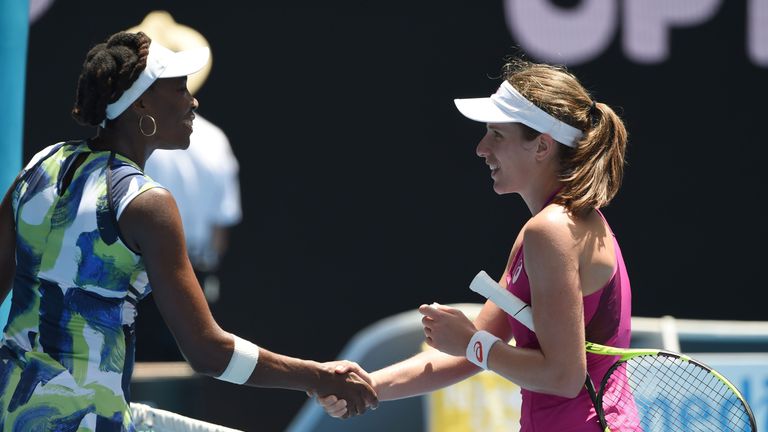 |
| Konta beats Venus Williams - who made her British tournament debut in Eastbourne in 1997 - in first round of Australian Open 2016 http://www.skysports.com/tennis/news/31851/10136038/johanna-konta-knocks-venus-williams-out-of-australian-open |
So what's changed? And where will she go from here? Will this prove to be her career peak? Or could she become a player like, for example, her semi final conqueror? Angelique Kerber made a similarly swift leap in the rankings a few years ago, and although she's suffered some dips in form, has become a fully-fledged member of the game's Elite.
According to Konta, the work on her psychology with Juan Coto, one of a trio of hugely influential Spaniards in her coaching team (led by Esteban Carril and Jose-Manuel Garcia) has been a major factor in her astounding improvement. She strongly credits this team for sticking with her after her LTA funding was cut.
She is now, she says, far less anxious on court, and in a fascinating interview with Donald McRae of The Guardian last October, she described how she "had to dig deep and find where my happiness comes from... The biggest part of the learning curve is accepting the lows and not getting too caught up in the highs either. Results come and go, tournaments come and go." Did everything suddenly click into place for her? "No. I really don't believe in that click moment. I believe in the process."
She says "The Process" are, for her, the key words.
Tuesday, 25 June 2013
Taking Warming-Up For Wimbledon To A New Level
Eastbourne offers invaluable preparation ahead of Wimbledon for numerous world-class tennis players. Whether on the practice courts or during actual match play. But Gilles Simon and Feliciano Lopez took it to a whole new level by tuning up for today's first round encounter at the All-England Club by playing each other in the Aegon International final!
It's just the luck of the draw, of course. Lopez and Simon knew, when the Wimbledon first round matches were revealed on Friday morning, that if they beat Ivan Dodig and Andreas Seppi respectively in the Eastbourne semi-finals, they would face each other twice in three days. And, incredibly, considering they've both been close to the top of the game for much of the last few years, they'd only played each other once before - in 2008.
The Eastbourne final was a high quality match, despite the fact that second-seed Simon had struggled with a bug for most of the week, and unseeded world no. 39 Lopez is on the comeback trail after missing a significant amount of the season so far with a wrist injury.
31 year old left-hander Feliciano is unusual for a Spaniard in having a game ideally suited to grass, with his serve-and-volley and backhand slice. He's a three-time Wimbledon quarter-finalist, but is perhaps best known with the wider British public for Judy Murray's "Deliciano Lopez" comments!
He appeared to have the edge throughout much of the first two sets of the competitive tussle, but Frenchman Gilles was showing his canny ability to rally without error and go for the right shots at the right time. Last week there were several occasions when it seemed his opponents might have too much game for him, but he confounded expectations - as he's often done throughout a career that has seen him reach the world's top ten. This was encapsulated when, close to losing the match in the second set tie-break, a return winner as Lopez attempted to serve-volley gave him the crucial mini-break to lead 6-4, going on to take the tie-break and set up a deciding set.
But the first grass court title of Feliciano Lopez's career turned out not to be far away as he dominated the final set to triumph 7-6 (7-2), 6-7 (5-7), 6-0.
And this evening Lopez repeated the result - defeating Simon, the 19th seed at Wimbledon, 6-2, 6-4, 7-6 (13-11). Simon, whose play improved considerably by the end of the match (that third set tie-break seeing some truly brilliant tennis from both men), was very unlucky to have to face such a dangerous opponent in the first round. Lopez's Eastbourne victory saw him rise to 32 in the new rankings list - high enough for a Grand Slam seeding but, of course, just too late for this year's Wimbledon.
Tuesday, 18 June 2013
Watching Stosur Across The Globe
Eastbourne seems to bring the best out of Sam Stosur when she plays Nadia Petrova.
Today Petrova, the world no. 13, and the Aegon International's eighth seed, was upset 6-2, 6-3 on Court Two in the first round by Australia's Stosur, currently ranked just one place below at world no.14, but therefore unseeded.
Their career head-to-head record now stands at 6-4 in Petrova's favour, and the only match where Stosur conceded as few as five games against her Russian rival took place - yes, you've guessed it - in the first round at Eastbourne 2011 (6-1, 6-4).
True, Petrova beat Stosur in the semi-finals of Eastbourne 2008, but that was in the days when Stosur was just beginning to emerge as a singles contender, following her huge success in the doubles game.
I watched Stosur beat Petrova on Court One in their first round encounter at Eastbourne 2011 - the Aussie's first victory over the Russian in five attempts. But it was their next meeting that would become probably the most significant of all their matches so far - certainly in terms of Sam Stosur's career.
Having had the opportunity to speak with her briefly during Eastbourne 2011, and tell her that my Aussie relatives in Brisbane were very proud of her as a fellow Queenslander, I was visiting them - as well as Sydney and Melbourne - a few months later, as the US Open began.
Watching the Australian TV commentators talking up her chances, I wondered how realistic they were being, and of course thought of the similar situation in the UK regarding Andy Murray. Sam's talent and potential is extraordinary, but the chances of her performing close enough to her best throughout the whole tournament didn't look good, even though her form had been reasonable during the North American hardcourt tournaments after Wimbledon 2011.
When it came to her third round match against Nadia Petrova, the commentators pointed out Sam's easy win against her at Eastbourne, and sounded confident of victory, even as she struggled in the second set, having taken the first.
However, when I turned the TV off in my Melbourne hotel room, and headed for the airport, Nadia was leading 3-1 in the final set. It was over 24 hours before I found the result on the internet during a stopover in Singapore. I was somewhat surprised to read that Sam had won, and later discovered it was the longest women's match in US Open history since the introduction of the tie-break. She went on to have another epic win against Maria Kirilenko, having to go to a third set after Maria won the longest tie-break in women's Grand Slam history, 17-15.
Given that she'd lost to Serena Williams a few weeks earlier in Toronto - and the fact that she'd underperformed in her only previous Grand Slam final (the 2010 French Open, against Schiavone), the chances of her playing the match of her life in the 2011 US Open final to beat an in-form Serena - which it seemed she might well need to do - looked remote. But that, of course, is exactly what happened.
Watching back in Eastbourne, it was close to midnight when she wrapped up the 6-2, 6-3 stunner; it was early evening in New York; and as she pointed out in the on-court interview, breakfast time in Queensland. My uncle, who has always been positive about "our darling Sam", including during some disappointing losses in the last few years, sent an email with the subject line, "We love you, Sam Stosur!"
Sunday, 26 May 2013
The French Open Begins, And Posters Spring Up In Eastbourne... The Tournament Must Be Fast Approaching!
So, the 2013 French Open is now under way. The match of the first day in the men's event has to be home hope Gilles Simon's five-set win over Australian former world no. 1 Lleyton Hewitt. The Frenchman led 5-0 in the final set, and withstood a fightback from the legendarily tenacious Hewitt to eventually triumph 3-6, 1-6, 6-4, 6-1, 7-5 - the first time in his career he's won from two sets down.
At the moment Simon is scheduled to be the top men's seed at this year's Aegon International, and he's just one of the images that have sprung up in Eastbourne in the last few days, advertising the event. The posters were up in time for yesterday's Eastbourne carnival, and include Agnieszka Radwanska, Fernando Verdasco, Heather Watson, Laura Robson and Caroline Wozniacki. The latter two, of course, are due to face off tomorrow in the first round in Paris.
For a full list of the men's and women's entrants for Eastbourne so far, go to the tournament's official website at: http://aegoninternational.co.uk, or my former stomping ground (well, I had features published there, at least!) of http://eastbournetennis.com, where I understand they exclusively revealed this year's likely entrants in early May.
Wednesday, 27 June 2012
Players Battle Wind, Bartoli - Paszek Epic, Roddick On Court 3, Angelique "More Wins Than Anyone Else" Kerber, Sharapova's Near-Nemesis, Champ Seppi, Nadal's Grass-Court Conqueror, Hotshot Harrison, And More!
Something of the supercalifragilisticexpialidocious to the title of this post, I know. But semi-finals (and quarter-finals as it turned out) day at the Aegon International was certainly action-packed. My VisitEastbourne guest blog on Friday's action can be read by clicking on this link: http://visit-eastbourne.blogspot.co.uk/2012/06/aegon-international-guest-blog-friday.html. To view all the guest blogs and entry features - from myself, Matthew Arnold, Gabriella De Feo, Jack Gracie, Tommy Curran, and Steph Temple, click on "Home" at the bottom of my Friday feature. Alternatively, you can view them all by simply clicking on this link: http://visit-eastbourne.blogspot.co.uk/
Monday, 18 June 2012
Hingis, Rusedski, Martinez and Philippoussis Take Centre Stage... While Qualifying Battles Continue
My guest blog, on yesterday's events at Devonshire Park, for the VisitEastbourne website, can be viewed by clicking this link:
http://visit-eastbourne.blogspot.co.uk/2012/06/aegon-international-guest-blog-sunday.html
http://visit-eastbourne.blogspot.co.uk/2012/06/aegon-international-guest-blog-sunday.html
Friday, 2 March 2012
Tickets for 2012
Less than two hours on from Andy Murray's great win over Novak Djokovic in the Dubai Duty Free Tennis Championships semi-finals, I thought I'd post a reminder about tickets for this year's Eastbourne event - where there's just a few hours left of the special purchase period, ahead of the general sale. Unfortunately, Murray and Djokovic - and also Federer and Nadal - seem unlikely to participate in this year's Eastbourne event. As a Premier WTA tournament, but only an ATP 250 event, it attracts plenty of the top-ranked women, but far less of the top-ranked men. The only realistic chance of one of the aforementioned male players entering the tournament would be if they didn't get enough matches at the Queen's Club or Halle events the week before. Last year, however, the Eastbourne men's field did include Jo-Wilfried Tsonga, Lleyton Hewitt and finalist Janko Tipsarevic, on his way to the world's top ten.
So, the tickets for the 2012 event, taking place from Saturday 16th - Saturday 23rd June: this year the LTA have appointed The Ticket Factory(TTF) to handle the sales and distribution (it was SeeTickets for the previous two years). Weekly centre court tickets are available by telephone only - not online. The UK phone number is 0844 581 1540. The special purchase period, allowing 2011 customers to book the same seat as last year (at 2012 prices), will close in a few hours - midnight UK time. After that, weekly tickets will still be available but, we're told, there are no guarantees the same seat will be available throughout the whole week.
The General Sale of tickets will not begin until 10am on Saturday 10th March. The Ticket Factory's box office phone number is 0844 581 3015, and the website is http://www.theticketfactory.com/.
Before then, this weekend sees the only opportunity to buy tickets in person at the Eastbourne box office, before the week of the tournament. The box office is at the International Tennis Centre, Devonshire Park, College Road, Eastbourne, BN21 4JJ, and will be open 9am - 5pm Saturday 3rd March and 9am - 2pm Sunday 4th March. Unlike last year, however, this box office will also be open one day before the tournament begins - Friday 15th June, 11am - 4pm.
Weekly Centre Court tickets are £200 (except for restricted views - £100 -£110). Full price centre court tickets are £27 per day, Sunday through Tuesday, then take a hike to £39 from Wednesday. The semi finals on Friday and finals on Saturday are £41 per day - with major reductions for restricted views, again. The good news for this year is that the first Saturday, 16th June, is Free access for ALL the courts. The bad news is that the seats in the North and West Stands of Court No.1 will be ticketed from Monday 18th through Friday 22nd. This means that those with only a ground pass can no longer see the big names in action on this court. Centre Court ticket holders will still have access to Court 1, but only the East Stand - more restricting.
Children are eligible for free ground passes every day, provided the "child" (aged 16 and under!) is accompanied by a paying adult, and the "child"'s ticket is requested when the accompanying adult purchases their ticket. Child ticket prices for Centre Court tickets are substantially less than adult tickets: £7 per day Sunday through Tuesday, £11 - 13 per day from Wednesday onwards. Adult ground passes are £14 per day Monday through Friday, £5 on finals day. Adult Court 1 tickets are £20 per day Monday through Thursday - again, substantially less for children. And there is a £2 reduction on ALL tickets for BTMs (British Tennis Members) and groups of 8 or more.
For more information, the somewhat complicated ticket system is presented clearly on the home page of http://www.eastbournetennis.com/, and there are also full details on the tournament's official website, http://www.aegoninternational.co.uk/.
2012 looks like being a big year for Eastbourne's Aegon International - the world's biggest grass-court Wimbledon warm-up tournament. Held just a few weeks before the Olympic tennis tournament takes place at Wimbledon, there are already rumours that the world's top players will use the Eastbourne venue for extra preparation for these two massive events. Don't delay investigating your options for tickets!
Saturday, 2 July 2011
Petra Kvitova, Wimbledon Champion - Can I Feel Smug?!
On the first day of the women's main draw matches at this year's Eastbourne tournament, a taxi driver told me he was considering taking his young son to the event. He asked me what they could expect to see with a ground pass that day. I told him that, among the attractions of the matches on the outer courts were some reasonably big name women players. I explained that a ground pass gives you access to part of Court One as well, and that one of the players scheduled to play there was Petra Kvitova. I said, "She's not hugely well-known if you're not an avid follower of tennis, but she could win Wimbledon."
I wonder if I was allowed to feel very smug today, as Petra was outhitting Maria Sharapova to strorm to stardom in the Wimbledon final.
The truth, of course, is that I was far from the only person tipping big things for the 21-year-old Czech left-hander. And, although I thought she was marginally ahead of Victoria Azarenka in being the most likely finalist from the bottom half of the draw, after the defeat of Venus Williams, before today's match I was picking Maria Sharapova as the most likely champion. I thought Maria was the slight favourite for the title from the start of the tournament. Lindsay Davenport made the same prediction, but shrewdly changed her mind before today's match.
Many other pundits, like me, persevered with the Sharapova pick. I didn't, however, agree with a couple of commentators who last night described it as Maria's match to win or lose. I thought it was more likely the other way round, as Kvitova has a little more in her game, but I wondered whether, when push came to shove, she was really ready to take her first Grand Slam title here and now. I thought she might well make too many errors, like she did in the Eastbourne final.
I'm happy I was wrong. She played an exhilirating match, at times the tennis was electrifying from both players, although Sharapova didn't produce enough of her best to make it a classic. But Petra's triumph over any gremlins that could have hampered her from playing her glorious game in the Wimbledon final was a joy. And a very positive sign for the future of women's tennis. Her game continues the new tradition of huge aggression off both forehand and backhand sides, as pioneered by Monica Seles, and extended by the likes of Lindsay Davenport and the Williams sisters, but adds some extra variety and flair, showing that maybe Martina Hingis and Justine Henin's brief periods of domination have left some kind of legacy.
The prediction now from several pundits is that Kvitova's Grand Slam triumph is "the first of many". That phrase has been banded about whenever a relatively young player has won a debut Major. More often than not, it seems, their career doesn't turn out to be as trophy-laden as predicted. There is, however, more reason in this case to believe we're talking about a multi-Grand Slam career. But that possibility is way too far in the distance to try to look at in close-up focus now. Wimbledon Champion 2011 is a pretty good achievement, to say the least.
Wednesday, 22 June 2011
Tennis All Over the World
Devonshire Park was still closed to the public yesterday evening, as the work deconstructing the stands around Court One, and the south and most of the east stand to Centre Court, continues for a couple more days. And the grounds that included the outer courts for the Aegon International are being prepared for public and tennis club use once again. There will be several tournaments throughout the rest of the summer, of course - including the county championships that Andy Murray surprisingly competed in a couple of years ago, before heading to the ATP Masters Series events in North America - but nothing on the professional scale of last week.
No sooner has the curtain gone down on Eastbourne's Aegon International, of course, before the curtain goes up on Wimbledon. This year, it seemed there wouldn't even be a day's break in-between, as bad weather threatened to spill the final matches over into Sunday. But with Centre Court less than a quarter full at 8:30pm on Saturday evening (in stark contrast to the packed house that saw Marion Bartoli defeat Petra Kvitova in the women's final a few hours earlier), the event was declared over as Janko Tipsarevic retired at 3-5 down in the deciding set of the men's final, Italy's Andreas Seppi taking his first ATP Tour title. Tipsarevic had been complaining about bad light since the start of the final set, around 7:15pm, and after a 20 minute rain delay he slipped and took a heavy tumble on the grass. He continued playing after treatment before pulling out as Seppi served for the match. His Wimbledon fears appeared justified, as yesterday he withdrew during his first round match against Ivo Karlovic.
On Saturday evening the crowd was told that the Eastbourne tournament was over for another year, and the decision had been taken to cancel the men's doubles final, the title to be shared. As I mentioned in my previous post, the final was to feature hotly-tipped youngster Grigor Dimitrov, teaming up with a certain Mr Andreas Seppi, taking on the recently reformed partnership of Jonathan Erlich and Andy Ram (who are no strangers to Eastbourne - the Israeli duo winning a crucial doubles match en route to a win over Britain in a 2006 Davis Cup tie). There was later a change of heart, however, with the final played on Sunday, not in Eastbourne, but Roehampton, South London, the site of the Wimbledon qualifying matches. Seppi was denied another title, with Erlich and Ram triumphing.
So, the circus has packed up and left town for another year. The international tennis tournament is a huge boost to a southern English resort, but of course it's only one of tens of stops on the WTA and ATP tours during the course of the January to November tennis season. In such a global sport as top level tennis, the contrasts of this big wide world were evident last winter (the English winter, that is), as I walked through Devonshire Park, days after the ten inches of snow had cleared (an unusually large amount for this part of the UK). I popped into the cafe which has the newspaper cutting on display, the one that features Caroline Wozniacki extolling the virtues of the cafe's ice creams. Wozniacki raved about these ice creams during her post-match press conference back in 2008, after her career's first big win, a second round triumph over Svetlana Kuznetsova. Now, two and a half years later, she was world no. 1 (and indeed, six months later, still is), and on the other side of the planet, the tennis world was preparing for the Australian Open. Down Under the climate was, of course, considerably different.
But last Australian summer, Queensland bore the brunt of the extraordinary, horrifying floods that brought catastrophe, and even tragedy, to large areas. I was in touch with my relatives in Brisbane, who were extremely lucky to avoid the waters that temporarily engulfed many parts of the city.
Days after the Brisbane International - a combined ATP and WTA tournament (and it was announced a few weeks ago that from next year the WTA event will be upgraded to Premier status) - the centre court was under water.
Sam Stosur, who had encountered the devastating effects of flooding as a child, when the Queensland town she lived in experienced such a fate, was among the tennis stars involved in fundraising.
Last week I had the pleasure of finally speaking with Sam Stosur (in 2008 I was present at her press conference at the beginning of her return to form after a lengthy lay-off through debilitating illness, but was only taking notes). I'd received an email from my uncle in Brisbane to say that he'd noticed she was playing in Eastbourne. I told her that my relatives were very proud of her as a fellow Queenslander, and she appeared genuinely chuffed.
This was after her great quarter-final win over in-form Vera Zvonereva. Sadly, this was one of her few really good recent victories. She fell 6-3, 6-1 to Marion Bartoli in the Eastbourne semi-finals, never getting her game going in very windy conditions, and yesterday tumbled out of Wimbledon in the first round to Hungary's world no. 262 (though former world no. 37) Melinda Czink.
It was the second year running Stosur has crashed out in the first round at Wimbledon after reaching the Eastbourne semi-finals. Indeed, she has reached the Eastbourne semis three times in the last four years, but has never progressed beyond Wimbledon's 3rd round. She can clearly play on grass, even though she believes it's possibly her worst surface. She can volley to back up one of the best serves in the women's game, and has a stellar doubles history, topping the world rankings for over a year in 2006-07; and has won four Grand Slam doubles titles (two Womens, two Mixed).
But she hasn't really lived up to expectations since her terrific run at last year's French Open really put her on the map, in terms of the singles game. There, she became one of the few players to beat both Henin and Serena in the same tournament, on her way to the final, where her surprising loss to Schiavone perhaps knocked her confidence. That's a shame, as she is one of the most enjoyable players to watch.
Many of Stosur's early round losses this year aren't as shocking as they appear, however, when you look at the names she lost to - mainly top players who have slightly slipped down the rankings, but enjoying a, sometimes brief, resurgence in form - or up-and-coming starlets: Svetlana Kuznetsova, Jelena Jankovic, Dinara Safina, Maria Sharapova, among the former; Petra Kvitova, Julia Goerges, Anastasia Pavlyuchenkova, among the latter. But her 3rd round French Open loss to Gisela Dulko, and now this Wimbledon defeat, are highly disappointing. She is a genuine contender to win any of the four Grand Slam events, but post Roland Garros 2010 has yet to play like that when it really matters.
Yet she's one of a large number of players who have a game, and a back-story (in Stosur's case, recovery from serious illness to reach new heights in her singles career), for crowds to savour; and hopefully there will be many such players gracing the Eastbourne tournament for years to come.
Friday, 17 June 2011
Watch Out For Those Youngsters!
So the Williams sisters may both now be out of the tournament, but there's no doubt their presence in Eastbourne has helped the event enormously, and probably given them both extremely useful work-outs ahead of Wimbledon, considering the lengthy lay-offs they've both endured.
In some ways, it's a similar situation to when they last played Eastbourne, in 1998, when they were both contenders for the title, but their defeats in the quarter-finals weren't devastating setbacks. Except that then they were hotly-tipped newcomers, with their futures as global superstars, and all-time greats of the game, by no means certain.
I still like telling anyone who'll listen about Venus's first tournament in Britain - Eastbourne 1997 - when she'd been sporadically playing tournaments for nearly three years, had been tipped as a future Wimbledon champion for even longer, and came through qualifying (having declined a wildcard in order to get more grass court practise) to reach the second round. Many of my friends hadn't heard of Venus Williams, or Anna Kournikova, who was playing Eastbourne's under-21 event that year.
These were the days of the Williams sisters' distinctive hair beads, and watching Venus play was their mother Oracene, and little sis Serena, fifteen years old, yet to make her debut on the Tour, but some predicting she'd be an even better player than her sibling.
One of the great features of an event like Eastbourne is that spectators have a chance to see players near the beginning of their careers. Over the years, numerous little-known youngsters have graced Devonshire Park and gone on to become tennis superstars.
Not all predictions are accurate, of course. But keep your eyes on up-and-coming Bulgarian Grigor Dimitrov. Just turned 20, and tipped as the new Federer by, among others, Roger's former coach Peter Lundgren, Dimitrov's helped maintain interest in a men's draw badly depleted of big - or even medium-sized - names, since the exits of Tsonga, Hewitt, Dolgopolov and Garcia-Lopez. He nearly lost to British wildcard Daniel Evans in the first round, but went on to reach the quarter-finals, where he lost to Janko Tipsarevic. But there's still a chance to see him play tomorrow, weather permitting, when he's due to play the men's doubles final, third on court one, not before 2pm. Dimitrov is partnering singles semi-finalist Andreas Seppi, and they take on Israeli duo Jonathan Erlich and Andy Ram.
If you're reading this, Jan and Lesley, two ladies I was talking to on Thursday (by the way, thank you for the strawberries, ladies!), I must apologise for telling you that the Dimitrov versus Tipsarevic match would follow the Stosur - Zvonareva epic on Centre Court. I later discovered it had been moved to court 4, following the rain-induced delayed start to the day, and the marathon opening matches on Centre.
It looks like Grigor Dimitrov won't get to play on Eastbourne's Centre Court this year, even if he wins the doubles title. But maybe - just maybe - those who saw him play will be able to tell future generations of the all-time great they watched at the beginning of his career.
Sunday, 12 June 2011
Sunshine, Rain, and the "Who's the Greatest?" Debate
Well, after such a promising opening day to the event yesterday, today has been a major frustration. We've been incredibly lucky to avoid major rain interruption for some years now. From memory, I think this is the first time since 1997 that an entire day's play has been washed out. The decision that there would be no chance of play today was announced at 4:50pm, not long before it was confirmed that the highly anticipated Aegon Championships final in London, between Andy Murray and Jo-Wilfried Tsonga, would also not be played today. Speculation grows as to whether Tsonga will make the jouney to Eastbourne after all.
Sunday's bad weather was well forecast, and the prediction for Saturday wasn't brilliant. But the first day was almost entirely sunny, albeit with a cold wind (quelle surprise!). There was some high quality tennis on a variety of different courts, as qualifying matches were crammed in. Perhaps the best match on centre court was between Brit Anne Keothavong and France's Alize Cornet. Keothavong overwhelmed higher-ranked Cornet, 8th seed in the qualifying event, but was the only one of five British women to reach the next stage.
All the men who won their first qualifying matches were back later in the day - and that included five Brits. All second round men's ties were also completed, with only Alex Slabinsky left to fly the flag for the UK in the final qualifying round. The biggest tennis names in that final round are Germany's 35 year old former world no.5 Rainer Schuettler, and America's former child prodigy Donald Young.
It seemed a day for players who were once tipped to reach the very top, are yet to achieve that, but when they play well, it's hard to take your eyes off them. Mirjana Lucic, who reached the Wimbledon semi-finals as a 17 year old in 1999, lost in the quarter finals of the Aegon Classic in Birmingham on Friday, but beat Yaroslava Shvedova at Eastbourne on Saturday. Indian superstar Sania Mirza won her opening match in three hard-fought sets. Austrian Tamira Paszek beat the USA's Vania King and is now the first woman through to the third qualifying round - without striking a ball - after her next opponent Greta Arn withdrew. Hungary's Arn beat Russian-born Australian Anastasia Rodionova, who won gold medals in singles and doubles at last year's Commonwealth Games. But Arn had a fall late on in the match, and completed it with a heavily-bandaged knee.
And Melanie Oudin, who wowed her home crowd - and much of the rest of the world - when she reached the US Open quarter finals as a 17 year old in 2009, easily beat China's Xinyun Han. I had the pleasure of speaking to her briefly, and telling her that I like the way she plays tennis, and the fact that her principal idol is the great Justine Henin.
When I referred to Serena Williams as the "Queen of Tennis" in my last post, I should explain that, in my opinion, if everyone had played close to their best, consistently, in the last few years, the rankings would have been a no-brainer: Henin first, Serena second, and Venus third. When Henin shocked the tennis world by retiring as world no. 1 in 2008, she had won seven Grand Slam titles - just one less than Serena (plus Olympic singles Gold, which Serena has yet to win), and the same number as Venus. By the time of Henin's return to the game at the start of 2010, Venus had won another Slam (Wimbledon 2008), and Serena had taken three more. As Henin tried to regain form in what turned out to be all-too-brief a comeback, Serena won a further two Slams, taking her career total so far to 13. Were it not for Henin's absence, the story could have been very different.
But Henin's absence, and difficulties in regaining form on her return, cannot be compared to Monica Seles's absence, and subsequent difficulties, which occured of course due to the most appallingly unnatural of circumstances - that stabbing incident. In Seles's case, her career total Grand Slam titles (9) versus that of her great rival Steffi Graf (22) have to be taken with a massive dollop of salt when assessing each player's greatness.
In the case of Justine and Serena, however, I can't object to Serena being declared the greatest of her generation.
And Venus isn't too bad a player, either.
I finally met her this Saturday. "Venus, it's so great to see you back in Eastbourne," I crawled, but meant it. "I remember when you first came here when you were 17 or 18."
"Thankyou," she smiled. "It's been a while."
Wednesday, 8 June 2011
The Queen of Tennis To Hold Court in Eastbourne
It's that time of the year again.
I'm back in Eastbourne after the French Open, and it's the start of those few weeks of the year in Britain when tennis seems to matter to the man or woman in the street. In this town, in particular, of course, with the tournament beginning this coming weekend. The promotion seems very good this year, in terms of omnipresence, with the giant posters of Tsonga and Ivanovic seemingly everywhere, and the controversially airbrushed pictures depicting Eastbourne as having a sandy beach, rather than the pebbled one it seems many residents are extremely proud of.
The financial benefits to the town are enormous in many different areas. Just last night a taxi driver was telling me that he must make sure to do several shifts next week. And, while tennis isn't necessarily the top topic of conversation with everyone in the town, it's clear that interest is growing. This morning I saw people stopping, doing an about-turn to confirm that they read correctly the headline on the newspaper stand: "SERENA JOINS VENUS AT TENNIS".
Yep, it's something of a coup. Many people thought Serena Williams wasn't likely to make her comeback until later in the summer, but now she's announced that she'll play her first tournament in nearly a year right here on the south coast of England.
If you didn't know, days after winning her 4th Wimbledon title - and 13th Grand Slam - last July, Serena suffered a freak mishap, cutting her foot on broken glass while at a restaurant. She still managed to play an exhibition extravaganza in Belgium, in front of a record crowd for a tennis match, standing in for an injured Justine Henin in what was originally billed "The Best of Belgium". She lost to Kim Clijsters, underwent surgery, and was out of the game for the rest of the year. Earlier this year the world was shocked by the news that the 29 year old had needed emergency surgery for blood clots on her lung. A few weeks ago she posted pictures of herself back on a tennis court, in practise, on her twitter site.
In many people's minds, whatever the rankings say, she's still the queen of tennis. Time will tell whether that crown can be officially restored.
Saturday, 4 June 2011
Li Na, The Chinese Confounder
I remember watching Li Na on Court One during Eastbourne 2008, an early round match against Nadia Petrova. I didn't know her game very well, and was wondering how, a couple of years earlier, she'd become the first ever Chinese player to reach a Grand Slam quarter final (Wimbledon 2006), and break the world's top 20. After she lost the first set and wasn't making much impact in the second, I texted a colleague to say, "I'm still wondering."
But she hung in there against a dominant Petrova, somehow eeking out the second set on a tie-break. She lost the final set, however, and my impression was of a solid and gritty but relatively unspectacular player.
Today I must eat my words as, at 29 years old, she celebrates becoming the first Asian winner of a Grand Slam singles title.
Her game has been gathering momentum for some time, of course. A couple of months after Eastbourne 2008, she beat Venus Williams in the quarter finals of the Beijing Olympics. And Venus didn't play particularly badly, Li was dominant and aggressive. Winning a medal for her country - at home - proved a step too far, however, as she lost to Dinara Safina in the semi finals, and then to Vera Zvonereva in the Bronze Medal Match. With Elena Dementieva beating Safina to take Gold in the final, it was a clean sweep for the Russians.
There had been a lot of talk, in the few years before the Beijing Olympics, of China being on the verge of making the kind of breakthrough in tennis, particularly on the women's side, comparable to Russia in the mid '00s. It still doesn't look very likely that there can be the sheer number of dominant players in the immediate future when you consider that Li (first Chinese player to reach the top ten, and now top five) and Zheng Jie (semi-finalist at both Wimbledon 2008 and Australian Open 2010) are the only ones from this new generation to have so far made top level impacts in singles. Also, the games of these top contenders can look easy to overpower when compared to the taller, more physically intimidating presences of most of the modern Russians.
But Li Na and Zheng Jie, despite being of smaller stature, can pack mighty punches. And, having gradually developed her game and confidence, Li has, incredibly, looked like the power player in the women's game this last fortnight. She beat hot title contenders Petra Kvitova and Victoria Azarenka in the fourth round and the quarters, before overwhelming Maria Sharapova - a player who has a far better serve and less of the matchplay frailties of many of her fellow Russians - in the semis. Li Na's ability to take the ball early, find the right angles at the right time, and an increasingly confident volley, have swept all before her. And, as she said herself, clay has always been her least best surface!
Defending champion Francesca Schiavone also confounded expectations by reaching the final. She could have won, but didn't manage to produce enough of her best tennis to overcome the formidable challenge Li posed today. I can't help feeling a bit disappointed that 30 year old Schiavone is one of the very few players able to provide old-fashioned flair and compete with modern power in the wake of Henin's departure.
But I can't help but be happy for Li Na. And the fact that such a big part of the world as Asia now has a Grand Slam champion has to be a good thing.
Tuesday, 31 May 2011
Two Hundred Miles from Eastbourne
Bonjour from Paris!
I feel privileged to be attending the second week of the greatest clay court tournament in the world, in one of the world's greatest cities. The weather provided a pleasing welcome yesterday evening when, an hour or so after cold and rain in Rouen, I was greeted by warm sunshine as I headed into Port d'Auteuil.
Having been offered a full press accreditation pass for either myself or my colleague to take up, to be brutally honest, I drew the short straw! So I made do with a visitor ground pass, while my colleague had access to Philippe Chatrier and Suzanne Lenglen Courts. But you make the best of things. I'd been on Centre and Lenglen before anyway, and for the first time I tasted the Court One experience.
And there was an added bonus of a match previously scheduled for Suzanne Lenglen Court. Maria "Maria, you're hot!" Kirilenko (I'm just remembering the chants from some local boys when she played Eastbourne a couple of years ago) took on the rising German star Andrea Petkovic. Like her slightly more hotly-tipped - but lower-seeded - compatriot Julia Georges, Petkovic is entered for this year's Eastbourne event.
And she'd already progressed further than Georges at Roland Garros by reaching the 4th round. Stuttgart champion Georges's loss to Marion Bartoli in the 3rd round was one of many shocks in the women's event so far. Even though Bartoli is ranked higher (11th to 17th), clay is certainly her least best surface.
Maria Kirilenko - an excellent doubles player who's scaled the world's top 20 and is seeded 25 - received some loud support in the less than half-full but atmospheric mini-stadium of Court One. One man was particularly vociferous, and led some of the crowd in noisy chants and songs. I was sitting very near to him at one point. I'm sorry, but I had to move. I love that kind of passion from fans and players, but I was virtually next to him, and it was ear-bleeding.
I was surprised by the mixture of seats on Court One - conventional "bucket-style" chairs at the lower levels, and benches on the top rows. You probably wouldn't want to sit on the benches all day, but they added to the more open-air, less formal atmosphere of a smaller show court.
Kirilenko and 15th seed Petkovic were very evenly matched, both being hard-hitting grunters with superbly powerful shots off both wings, enough tactical know-how, but not exactly the flair of a Henin, Mauresmo, Schiavone or even Radwanska.
It's a sign of the times that this style of play, once unique when pioneered by the revolutionary, individual Monica Seles, is now so common-place in the women's game that there are literally hundreds of women who play like this. Kirilenko and Petkovic do it better than most, but last night they looked very much like players a little below the top level. Sharapova, on Centre Court, was doing it so much better.
Still, it was an entertaining, competitive match, and the more likely winner took it in three. Petkovic performed her trademark dance at the end after sealing it 6-2, 2-6, 6-4. She was receiving vociferous support of her own by the end. No doubt some of it from German fans understandably excited by the best period in their national women's game since the days of Steffi Graf and Anke Huber, and Petkovic's delight was infectious.
Court One is a monumental sight from the outside, with all the singles champions' names engraved on individual slabs at the top. We're talking over a hundred slabs, of course. It circles from H Briggs in 1891 through to Nadal and Schiavone in 2010, with around ten to twenty slabs spare for engraving the forthcoming champions, before the circle is complete. I wonder if the organisers have considered what to do then?
If you don't know, the French Championships, as they then were, were only open to French residents until the 1920s. So it was quite a surprise for me to discover that Mr H Briggs (I've still to trace his full first name) was British. The sole non-French champion before Kornelia Bouman of the Netherlands took the women's crown in 1927, was however a resident of France. Only one British man has won the title since - Fred Perry in 1935. Could Andy Murray change all that this weekend?
The first six slabs have just one name on them - women didn't compete until 1897. The first female champion was F Masson. In my research, I've found her named, sometimes "Francoise" and sometimes "Adine Masson". Whichever she preferred, she won the Championships for the first three years, and took the title a further twice. Hope that helps for trivia anoraks like me.
There is, of course, also plenty of opportunity to share in the atmosphere of the crowd around the Place des Mousquetaires, between Court Philippe-Chatrier and Court One, watching the big court action on the gigantic screen. It's comparable to Wimbledon's "Henman Hill" (or is it "Murray Mound"? Take your pick.)
Today saw Andy Murray complete his match against Serbia's Viktor Troicki, which was stopped at two sets all due to bad light yesterday evening. A true comeback win - two sets to love down and trailing 2-5 in the final set, he played more aggressively at key moments to seal the decider 7-5.
Gael Monfils saw his impressive run end with a straight sets loss to an under the radar Roger Federer. I've been used to seeing Jo-Wilfried Tsonga's adverts for Kinder Bueno on mainstream French TV each time I've visited France in the last few months. Now, I regularly see Monfils in a milk or orange juice or something advert (sorry to the brand, I clearly haven't seen it enough times to remember it yet). Both men are extremely marketable and exhilarating for French tennis. They're both Grand Slam title contenders, but still always a very outside bet.
The images of Tsonga and Ana Ivanovic have been plastered all over Eastbourne in the last few weeks. They both have charisma and considerable tennis talent. The biggest "names" entered into the tournament are Venus Williams and Lleyton Hewitt. But perhaps organisers feel that, as they've both been out injured for some time - as well as being nearer to the "dirty thirty" age mark - that Tsonga and Ivanovic are safer bets. They both have extra time to prepare for grass, having lost in the 3rd and 1st round respectively, at Roland Garros.
Also today, Francesca Schiavone scored a win for flair with a 1-6, 7-5, 7-5 triumph over an impressive Anastasia Pavlyuchenkova (another Eastbourne 2011 entrant). And Marion Bartoli - who brings to mind more of the spirit and game of Monica Seles - delighted her home crowd by beating two-time Grand Slam champion Svetlana Kuznetsova.
So it's Schiavone versus Bartoli in the semi finals. Both Eastbourne regulars, entered again for this year's event, and a guarantee, in my opinion, of an interesting player in the French Open final.
Thursday, 27 January 2011
Henin Heartbreak
I couldn't believe it when, as I started to read a report on Justine Henin's emotional "End of Career" address on her website, the record that began playing on my radio was Johnny Cash's version of Hurt. This stunning track is often featured on TV soundtracks when reflecting highly charged sports moments, where you presume the original themes of Trent Reznor's song - self-harm and addiction - aren't meant to be taken too literally.
I love Johnny Cash, particularly his later work. Coldplay, on the other hand, I like and respect but am not a passionate fan (similar to my feelings regarding Pete Sampras, I suppose). Yet a few years ago, a friend of mine, who was a Taekwondo champion before suffering a horrendous injury, told me what the song The Hardest Part meant to her: it reminded her of not being able to participate in the sport she loved. I wondered why, until I realised that, like a lot of songs, it was one I'd heard for years, but hadn't paid much attention to until I'd been heavily directed towards it. When I heard the lyrics, "And the hardest part/ Was letting go/ Not taking part", I understood.
What song could be more appropriate to such a situation as Justine Henin being forced out of tennis with an elbow injury? So you can probably guess what song was played, on BBC Radio 2, just a couple of hours after the Johnny Cash moment - at the end of a very bad day, not just for Henin fans like me but, I believe, the women's game, tennis, and sport as a whole? It's one of Coldplay's lesser-played records. I doubt its relevance to the day was recognised by the radio programmers here in the UK, where Henin's retirement heralded a mention in the sports bulletins, and zero attention in the general news. Synchronicity? As Melbourne's "housewife superstar" Dame Edna Everage might say: "Spoooky!"
Sunday, 24 October 2010
Tickets On Sale NOW
Well, I'm not the only person to be taken by surprise by this: Tickets for the 2011 Aegon International are ALREADY on sale! The 2010 event saw the move to a centralised box office - which was by no means universally popular, shall we say? - and the distribution of tickets wasn't announced until around three months before the tournament.
I received my first free text alerts regarding the 2011 event on Friday (hopefully I'll be involved in sending them out again, come the event), from eastbournetennis.com and eastbournetennis.net. More info on ticket availability is now on the aforementioned websites.
If you're in the Eastbourne area, there's still a couple of hours left to buy your tickets on site this afternoon (open till 5pm at the International Tennis Centre, Centre Court Building, Devonshire Park). The ONLY other dates you'll be able to buy tickets ON SITE before Saturday 11th June next year, according to the letter sent out by tournament director Gavin Fletcher, will be next weekend (Saturday 30th and Sunday 31st October, 10am - 5pm, both days). The other options, of course, are online or by telephone. There's a slight reduction (generally around £1 for a daily ticket, £5 for a weekly one) if you purchase before 4th January 2011.
I know there've been problems submitting comments to these blogspot pages, but if you are able to submit comments or experiences regarding buying tickets, they will of course be very welcome.
Monday, 19 July 2010
Everyone's a Critic...
One of my favourite writers is actually Alison Graham, TV editor of the Radio Times. If you don't know the publication, that isn't an oxymoron - the magazine was founded in the 1920s to cover the fledgling BBC radio service. Still run by the BBC, it now covers all British TV and radio. Her funniest work was the now sadly erstwhile "Soap and Flannel" coverage of the top British soap operas, but her previews and weekly TV column are brilliantly written, entertaining and often thought-provoking. Of course, you're never going to agree with everything a critic says. And, as befitting someone who's TV preferences I feel tend to veer more towards style than substance, I sometimes wonder if she spins a roulette wheel to decide which opinion she's going to have, before wrapping her wonderful writing style around it. Ah, the curse of having those empty column inches to fill!
This week, she's gone for the particularly contentious, rejoicing at the axing of Where the Warm Heartbeat Practice Is - or is it just called Heartbeat? - the zenith of those cosy Sunday night dramas. A few years ago she remarked on the torrent of disagreement she received when criticising the show.
Oh, and there's a little aside about Wimbledon: "Tennis commentary is the most pointless of all sports' commentaries. What's to say about two people who thump a ball with metronomic tedium, to and fro, across a net?"
As pointless as writing millions of words about a few moving pictures on the front of a box, perhaps?
Friday, 16 July 2010
Reasons To Be Cheerful?
So, it was an even bigger "must-win", and "should-win", tie than team GB's previous few Davis Cup match-ups; but this time they obliged. Britain is safe from relegation - for now - to the lowest possible tier of the competition. With a perfect 5-0 win last weekend, they're free to continue playing at the dizzying heights of Euro-Africa Zone Group Two. If things go well, they could play, at the end of next year, for promotion to Euro-Africa Zone Group One.
Which means it's hardly a cause for spectacular celebration. Accordingly, the festivities were a little subdued - from the team and the crowd - as Colin Fleming and Ken Skupski secured the tie victory by winning the doubles rubber on Saturday. They knew they'd done what they had to do, hopefully part of a building block.
With no south stand or additional rows to the east stand - those temporary seats are taken away at the end of the Aegon International - the remaining seating never looked more than sixty percent full, and that was probably a generous estimation. BBC local radio was told that around 2000 of the 5000 available tickets had been sold.
Considering July weather is as unpredictable as the rest of the year in Britain, the weather was the same as the last Davis Cup tie to be held in Eastbourne (July 2006) - far hotter than the June tournament's been in the last twenty years. In '06 I was in the east stand, and a slight lack of sun lotion on my wrist led to my first sunburning in Britain since I was a child! This time I was in the west stand, and later in the afternoon, given all the empty seats, was able to move up into the shade.
The "tennis village" of shops also wasn't as large in terms of number of stalls as during the Aegon International, but there was still some decent memorabilia on sale.
So, a pretty good weekend for all who attended. And the few Turkish supporters, who were barely visible in the crowd, probably didn't have too many expectations of a tie win. Though they might have harboured realistic hopes Turkish no. 1 Marsel Ilhan would beat James Ward in the second rubber. Although he'd lost to Ward in two close matches earlier this year, he's ranked 200 places higher than the Brit, and recently qualified for Wimbledon and reached the second round. But Ward showed some of the great form that saw him beat Feliciano Lopez and Rainer Schuettler at Eastbourne three weeks before.
The criticism of British tennis goes on, of course, and justifiably. Brit Richard Bloomfield, who had a terrific run to the semi-finals of the ATP tournament in Newport last week, has joined the seemingly endless number of people to question the LTA's running of the British game.
But Ward, Fleming, Skupski and Jamie Baker look like impressive late bloomers, albeit at a modest level. It was particularly cheering to see Baker play his first Davis Cup since the World Group match against Argentina in early 2008. Although Britain lost the tie, Baker impressed with his wholly unexpected victory in the dead rubber, defeating Agustin Calleri on clay in Buenos Aires. But his progress was shockingly derailed by life-threatening illness. Now thankfully recovered, he's risen back up from 1000 in the world to just outside the top 250.
Right now, and in the immediate future, Britain of course need Andy Murray if they're to do anything noteworthy in the Davis Cup. And there's no chance of being back in the World Group before 2013. But at least there are tiny signs of some back-up for Murray in big ties, providing he plays.
Wednesday, 7 July 2010
Davis Comes To Town
So, Eastbourne isn't quite done with world class tennis events this year. Just three weeks after the Aegon International, and the Davis Cup has come to town. It's the first time the prestigious men's team event has been hosted in the town since Great Britain faced Israel in a Euro/Africa Zone Group One tie in July 2006. GB needed to beat Israel to avoid a relegation play-off. They lost.
Four years on, if they lose to Turkey, Britain will be relegated to the lowest possible tier: Euro/Africa Zone Three. It's scarcely believable that the country that gives the world Wimbledon - and, of course, makes considerable money from the Grand Slam event - should be in such a position.
The Davis Cup is more low-key in its preparations than the Aegon International. Devonshire Park was still open to the public yesterday, as both the British and Turkish teams practised ahead of Friday's opening rubbers.
There isn't the buzz surrounding the event that there was in 2006. Much of it surrounded Andy Murray, whose singles rubber win against renowned Israeli doubles specialist Andy Ram was not only his first career win from two sets down, but also his first ever five sets triumph.
This time there aren't the star names to excite the crowds, and there's louder disappointment at the continued stagnation of the British men's game below - well below - Mr Murray. But Colin Fleming and Ken Skupski are becoming quite a useful doubles pairing - 2 ATP titles and the Eastbourne final among their highlights in the last year - and James Ward played way above expectations at the Eastbourne singles event. But, even though few fervent tennis fans outside Turkey can tell you much about the Turkish players, British fans know only too well that no opposition can be written off.
Subscribe to:
Posts (Atom)